
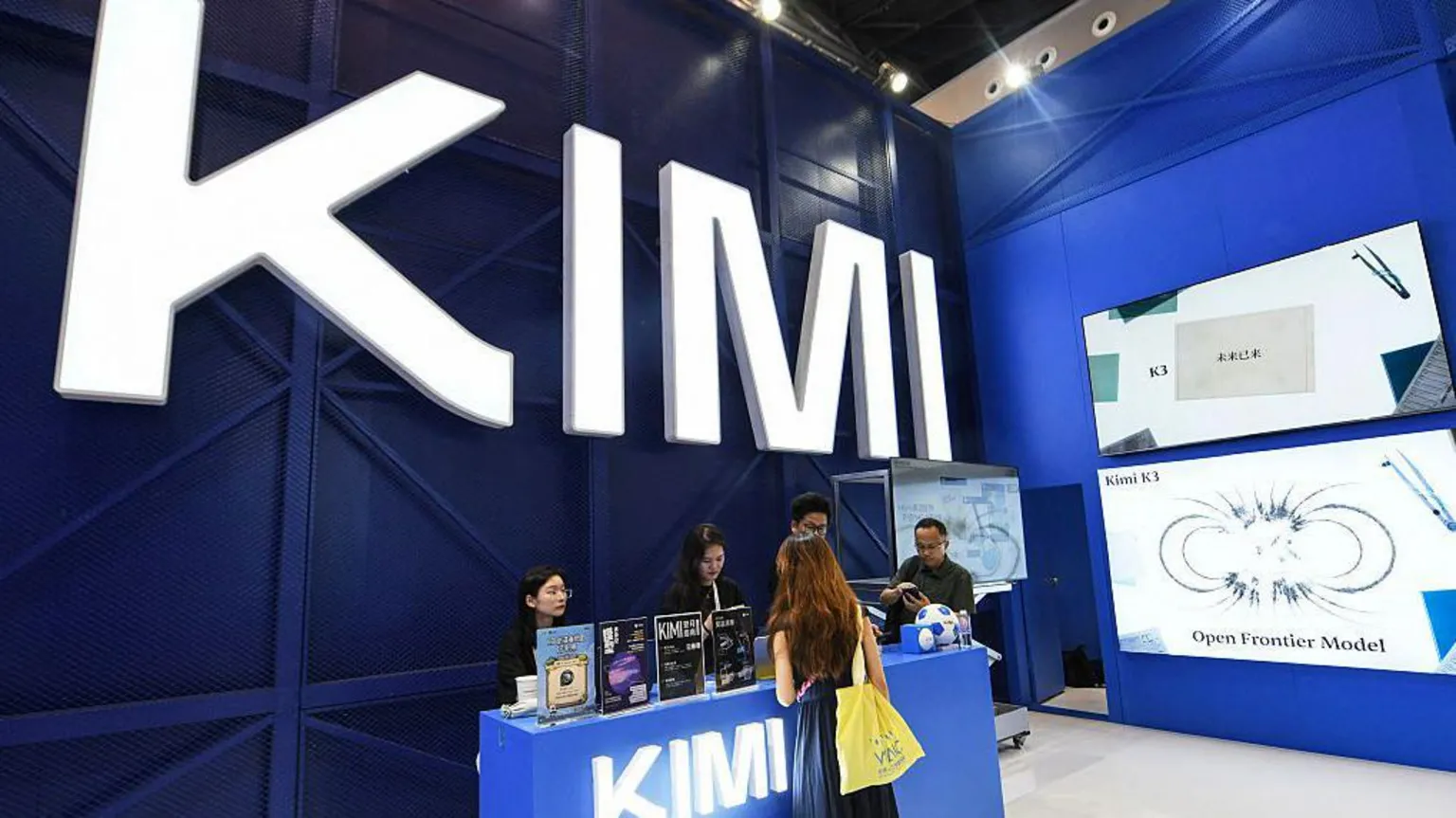
Moonshot AI: A Deep Dive
Business model, technology, competitive position and risk

About this paper
Moonshot AI (月之暗面) is a private Chinese company. It has never published audited financial statements, has not filed a listing prospectus, and discloses operating metrics selectively and irregularly. Every revenue, valuation, cost and user figure in this paper is therefore either a company statement, an advisor statement, a third-party tracker estimate, or press reporting from unnamed sources. None of it is audited.
We have tried to be explicit about which is which. Where sources conflict, we state the conflict rather than silently picking a number. Where a widely-circulated figure does not survive checking, we say so and exclude it. A note on method and a full list of known limitations appear at the end.
Two conventions used throughout:
• Metric labels. Chinese user-scale figures are worthless without a metric and a panel. We label every one as MAU or WAU or DAU, app-only or all-surfaces, and name the tracker. Figures from different panels are never charted or compared directly.
• Dated denominators. Revenue multiples are stated against a specific ARR figure on a specific date. In a company whose revenue tripled in three months, an undated multiple is meaningless.
1. Executive summary
Moonshot AI is the sharpest available test of a specific proposition: whether a small, technically excellent Chinese AI lab with no consumer distribution can convert open-weight model releases into a durable developer-platform business, fast enough to justify a valuation that has risen roughly seven-fold in nine months — on a reported, and as yet unclosed, pre-money mark.
The business has been rebuilt. Moonshot spent 2023–2024 as a consumer chatbot company and lost. Kimi’s China app MAU peaked in Q1 2025 and fell roughly 60% over the following twelve months, to 8.34 million by Q1 2026 — ninth place in a market whose leader, ByteDance’s Doubao, reports 345 million. The company responded by cutting consumer marketing to almost nothing and rebuilding around open weights and a developer API. That pivot has worked commercially: reported ARR went from roughly $100 million in Q1 2026 to $300 million in June 2026, with more than 70% of it now coming from the API rather than consumer subscriptions.
The technology is genuinely first-rank. Kimi K3, announced 16 July 2026, is a 2.8-trillion-parameter mixture-of-experts model with a 1,048,576-token context window. It sits fourth on the Artificial Analysis Intelligence Index, behind only Anthropic’s Claude Fable 5 and two configurations of OpenAI’s GPT-5.6 Sol, and it is the strongest model whose weights are scheduled for public release. The underlying work — the MuonClip optimiser, Kimi Delta Attention, the Mooncake serving architecture — is published, peer-reviewed in part, and has been independently influential. This is not a fast-follower.
The economics are unproven and the valuation is not. No gross margin has ever been disclosed. Moonshot’s two closest listed Chinese comparables report gross margins of 23.3% (MiniMax, 9M 2025) and 50.0% (Zhipu, H1 2025) — a spread wide enough that “somewhere in between” is not an answer. Against $300 million of ARR, the reported $31.5 billion pre-money of the round currently in progress implies roughly 105× revenue; the $50 billion pre-IPO target implies roughly 167×. For reference, OpenAI trades at roughly 65× trailing 2025 revenue and Anthropic at roughly 21× its current run-rate. Moonshot is being priced at roughly 1.6 to 8 times the multiple of the two Western labs it benchmarks against, on a small fraction of their revenue base.
The near-term risk is political, not commercial. On 22 July 2026, the Director of the White House Office of Science and Technology Policy publicly accused Moonshot of operating a platform to conduct large-scale distillation against US models, and the Treasury Secretary said sanctions and Entity List designations were “on the table.” Neither statement was accompanied by published evidence, and OSTP subsequently softened its characterisation of what it holds from “solid evidence” to “information.” No enforcement action has been taken. But the threat lands precisely on the pre-IPO financing window, and Entity List designation would cut US cloud distribution, US enterprise customers and Western underwriting simultaneously.
The structural constraint is compute. K3’s launch demand exceeded capacity within 48 hours and forced Moonshot to suspend all new paid consumer subscriptions on 19 July 2026 — a demand signal, but also a hard ceiling. Moonshot trained K2 on export-restricted H800s. Its access to the current NVIDIA generation is the subject of accusations made on 22 July; no Moonshot-specific probe has been confirmed. Serving a 2.8-trillion-parameter model requires roughly 1.4 terabytes of GPU memory even at four-bit quantisation, which is multi-node datacentre infrastructure. Compute is the binding input to both training the next model and monetising the current one, and it is the input Moonshot controls least.
The judgement. The technical case for Moonshot is strong and the commercial inflection is real. The valuation embeds an assumption that the current growth rate persists, with essentially no margin for it to normalise, at a moment when the two largest determinants of the outcome — US enforcement posture and access to frontier compute — are both outside management’s control and both actively deteriorating. This is a high-conviction technology story attached to a valuation that requires almost everything to go right.
2. Company overview
2.1 Founding and thesis
Moonshot AI was founded in March 2023 in Beijing. The name is a reference to Pink Floyd’s The Dark Side of the Moon, launched on the album’s fiftieth anniversary; the Chinese name 月之暗面 is a direct translation. The Kimi chatbot launched in October 2023 — a distinction worth preserving, because the launch date is frequently reported as the founding date.
The founding decision came from watching ChatGPT’s release. Yang Zhilin, in a March 2024 interview:
“2022年11月,ChatGPT发布那天,你在做什么?杨植麟:我正在筹备这个事,找人组团队,碰撞一些新认知。看到ChatGPT很激动。…ChatGPT刺激了变量,使生产要素齐全。”
“November 2022, the day ChatGPT was released — what were you doing? Yang Zhilin: I was already preparing this, finding people to build a team, testing out some new ideas. Seeing ChatGPT was thrilling. … ChatGPT changed the variables; it made all the factors of production available at once.”
By his own account he calculated overnight that roughly $100 million had to be raised within months, and identified February 2023 as the only viable window — earlier would have preceded market readiness, later would have missed it entirely.
Two product decisions were made at founding and shaped everything since. First, that long context would be the differentiated technical capability. Second, that the company would build one consumer product only, rather than pursuing enterprise revenue or vertical applications:
“他没有像他的对手那样,做更稳妥的to B生意,或是在医疗、游戏等细分场景中找落地,而是做且只做了一款to C产品——智能助手Kimi,支持20万汉字输入。”
“Unlike his competitors, he did not take the safer B2B route, nor look for a foothold in verticals like healthcare or gaming. He built one and only one consumer product — the Kimi assistant, supporting 200,000 Chinese characters of input.”
The second of those decisions has since been reversed in substance, which is the central fact of the company’s 2025–2026 history. The first has not.
Yang has been consistent that the ambition is not regional:
“我们不想做中国的什么东西,也不一定想做OpenAI。…真正AGI肯定是全球化的,不存在由于市场保护机制导致你只能做某个regional market的AGI公司。”
“We don’t want to be the Chinese version of anything, and not necessarily OpenAI either. … Real AGI is inherently global; there is no such thing as an AGI company confined to one regional market by protectionism.”
2.2 Founders and key people
Moonshot has four co-founders, all Tsinghua University alumni, all still technically active as of mid-2026 — each appears in the contributor list of the Kimi K2 technical report and in the project leadership of the Kimi Linear paper.
Yang Zhilin (杨植麟) — founder and CEO. Born 1992 in Shantou, Guangdong; the youngest CEO among China’s leading LLM companies. Graduated Tsinghua in 2015, having transferred from thermal engineering into computer science, where his undergraduate advisor was Jie Tang. Completed a PhD at Carnegie Mellon University’s School of Computer Science in 2019 — four years against a typical six — advised by Ruslan Salakhutdinov (then Director of AI Research at Apple) and William W. Cohen (principal scientist at Google DeepMind). He was first author on papers co-authored with both Yann LeCun (GLoMo) and Yoshua Bengio (HotpotQA), and on Transformer-XL and XLNet. He interned at Google Brain and at Meta during his doctorate, and between 2020 and 2021 worked on Huawei’s PanGu models and led the Wu Dao (悟道) project at BAAI. He co-founded Recurrent AI (循环智能) in 2016, at 23, with Zhang Yutao.
Zhang Yutao (张宇韬) — co-founder and CTO. PhD in computer science from Tsinghua. Co-founder of Recurrent AI with Yang, and named alongside him as a respondent in the November 2024 Hong Kong arbitration discussed in §7.5. His specific research focus is less publicly documented than the other three co-founders’.
Zhou Xinyu (周昕宇) — co-founder, algorithms and engineering. Previously at Hulu, Tencent and Megvii (Face++), where he was a co-founder. Co-author of ShuffleNet, DoReFa-Net and the EAST text detection framework.
Wu Yuxin (吴育昕) — co-founder. Previously at Google Brain (foundation models) and Meta AI Research (computer vision). Author of Group Normalization and creator of Detectron2, Meta’s widely-used object detection and segmentation library.
Yang, Zhou and Wu were bandmates in a Tsinghua rock band called Splay, named after the splay tree data structure.
Naming caution. Two figures with similar names appear in coverage of Moonshot and must not be merged. Zhang Yutao (张宇韬) is the co-founder and CTO. Zhang Yutong (张予彤) is a former GSR Ventures partner, not a founder or employee, who is alleged to hold a significant equity position obtained without disclosure to her then-employer — a fact material to the Recurrent AI arbitration. English-language coverage frequently conflates the two. English Wikipedia additionally renders two co-founders’ names incorrectly (周昱宇 for 周昕宇; 吴育鑫 for 吴育昕).
Headcount is approximately 300 as of mid-2026 — among the smallest of any frontier AI lab worldwide. This is deliberate. Yang, June 2026:
“在这些大模型创业公司里,我们的人数一直是最少的。保持最高的GPU与人的比例是关键。”
“Among these large-model startups, we have consistently kept the smallest headcount. Maintaining the highest ratio of GPUs to people is critical.”
At $300 million of ARR, that implies roughly $1 million of ARR per employee — a figure that flatters the business, since it excludes the compute that substitutes for the headcount.
2.3 Governance and ownership
Yang Zhilin is the legal representative and actual controller of Beijing Moonshot AI Technology Co., Ltd., the domestic operating entity, and functions as sole strategic decision-maker. A multi-class share structure is reported to reinforce founder voting power beyond economic ownership; the specific vote ratio per class has not been disclosed. The board is understood to include representatives of the founding team, HongShan and Alibaba. Exact seat count and voting thresholds are not public.
Specific equity percentages should be treated with caution. Precise figures for founder and investor stakes in the domestic entity circulate widely (typically: Yang 51.83%, Zhou Xinyu 6.56%, Wu Yuxin 3.91%, Zhang Yutao 3.33%, founders 65.63% combined; IDG affiliates 16.46%). We could not substantiate any of them against a filing or a reputable primary outlet. Their precision suggests a scrape of a domestic corporate registry, which would not reflect the offshore cap table through which most institutional money is held. We report them here only to identify them as unverified, and we do not use them anywhere in the analysis.
The one equity figure with a named on-record source is the disputed ~36% stake attributed to Alibaba — accurate as of the February 2024 round, when Alibaba invested roughly $800 million, but heavily diluted by four subsequent closed rounds and a fifth in progress. Stating it in the present tense, as much coverage does, is misleading.
Moonshot originally used an offshore red-chip structure. In May 2026 it began unwinding that structure in preparation for a Hong Kong listing, with foreign investors expected to hold through a joint-venture arrangement post-restructuring. Bloomberg has reported preliminary discussions with Goldman Sachs and CICC; no sponsor mandate has been confirmed, and no A1 application had been filed with HKEX as of late July 2026.
3. Products and business model
3.1 Product portfolio
Moonshot operates a hybrid consumer-plus-developer model under the Kimi brand, comprising five products as of July 2026.
Product | Category | Distribution | Notes |
Kimi Chat | Consumer chatbot | Web, iOS, Android | Freemium; four paid tiers in China, four internationally |
Kimi Work | Productivity suite | Web, desktop | Research, documents, slides, spreadsheets |
Kimi Code | Developer CLI agent | Terminal | Command-line coding agent |
Kimi Work Desktop Agent | Agentic automation | macOS, Windows (June 2026) | “Agent Swarm”: up to 300 sub-agents, 4,000 steps |
Open Platform API | Developer / enterprise | REST API; open weights via Hugging Face | Per-token pricing; MCP tool integration |
The desktop agent is the current product frontier and is aimed squarely at enterprise automation. Developer documentation now sits at platform.kimi.ai.
3.2 Model lineage
Release | Date | Key specifications |
Kimi (initial) | Oct 2023 | 200,000 Chinese characters of context |
Kimi (expanded) | 18 Mar 2024 | 2,000,000 Chinese characters |
K1.5 | Jan 2025 | Reasoning model; multimodal RL |
K2 | Jul 2025 | 1.04T total / 32B activated; 384 experts; 15.5T training tokens; 128K context; open weights |
K2-0905 | Sep 2025 | Updated K2 checkpoint; SWE-bench Verified 69.2 |
K2 Thinking | Nov 2025 | Reasoning-optimised variant |
K2.5 | Jan 2026 | Native multimodal; commercial inflection point |
K2.6 | Apr 2026 | Incremental; strongest open-weight model of its moment |
K2.7 Code | Jun 2026 | Code-specialised variant |
K3 | 16 Jul 2026 | 2.8T total / 16 of 896 experts; 1,048,576-token context; weights scheduled 27 Jul 2026 |
On context units. Moonshot has always marketed context in Chinese characters (字), not tokens. The two are not interchangeable: Chinese text tokenises at roughly 0.55–0.85 tokens per character, so the 2023 launch figure of 200,000 characters corresponds to something on the order of 110,000–170,000 tokens. Much English-language coverage converts this to a flat “128K tokens,” which is an artefact of translation rather than a specification. Token figures from K2 onward are genuine token counts.
3.3 Revenue architecture
Track 1 — API. Per-token pricing through the Open Platform, currently:
Model | Input (/M tokens) | Notes | |
K3 | 3.00 | 15.00 | Flagship; cache-hit input $0.30 |
K2.6 | 0.95 | 4.00 | Balanced tier |
K2.5 | 0.60 | 3.00 | Cost-efficient tier |
K-series pricing is flat across context length — there is no long-context surcharge. This is a real differentiator against Google and OpenAI, both of which apply premium rates above a context threshold; it is not a differentiator against Anthropic, which has priced flat to 1M since Claude 4.6. Moonshot’s legacy moonshot-v1 endpoints remain tiered by context length and are scheduled to sunset on 31 August 2026.
Track 2 — consumer subscriptions. Moonshot runs two distinct tier ladders, which are frequently reported as though they were competing accounts of the same thing:
Market | Tiers |
China (¥/month) | Adagio ¥0 · Andante ¥49 · Moderato ¥99 · Allegretto ¥199 · Allegro ¥699 |
International (US$/month) | Free · Moderato $19 · Allegretto $39 · Allegro $99 · Vivace $199 |
On 19 July 2026 Moonshot restructured this, splitting general membership from a separately-priced Coding Plan. The practical effect was a substantial increase in the cost of a full-capability subscription: the minimum viable combination rose from roughly ¥468 per year to roughly ¥1,536, a 3.3× increase. The same weekend, all new paid consumer subscriptions were suspended entirely (§7.3).
Two subscription figures in circulation are wrong and are not used here. A “5.2 yuan / 4 days to 399 yuan / year” schedule was a May 2024 tipping mechanism (送Kimi一朵花, “give Kimi a flower”) that bought peak-hour compute priority, not a membership tier. A “Kimi Pro at ~¥150 / ~$21 per month” tier has never existed.
3.4 The open-weight strategy
Moonshot began releasing open weights with K2 in July 2025, under a modified MIT licence. The licence is permissive with one condition: organisations exceeding 100 million MAU or $20 million in monthly revenue must prominently display “Kimi K2” in their user interface. There is no fee and no revocation right — this is an attribution requirement, not a commercial licence.
The strategy functions as a developer-acquisition channel with no marketing spend attached. K2 reached #1 among open models and #5 overall on LMArena in July 2025 on more than 3,000 blind votes, and was the #1 trending model on Hugging Face at launch. The intended mechanism is a flywheel: open weights generate benchmark visibility and organic adoption, adoption generates evaluation on self-hosted infrastructure, and evaluation converts to hosted API revenue when workloads reach a scale where self-hosting is uneconomic.
Moonshot’s own stated rationale, from the K2 release:
“To spur further progress in Agentic Intelligence, we are open-sourcing our base and post-trained checkpoints.”
Two qualifications matter to the investment case. First, self-hosted deployment generates zero revenue for Moonshot — the entire monetisation depends on conversion to the hosted API or to consumer subscriptions. Second, the conversion mechanism is underwritten by the sheer size of the models: as §5.3 shows, self-hosting K3 requires roughly 1.4 terabytes of GPU memory even at four-bit quantisation, which is datacentre infrastructure rather than a workstation. The open-weight strategy and the API business are complements precisely because the models are too large for most adopters to run.
4. Financial profile
4.1 Revenue trajectory and mix
The most material fact about Moonshot’s 2026 is the velocity of revenue growth.
Date | Reported ARR | Note |
FY2025 | Single-digit millions (inferred) | Not disclosed; see note below |
Q1 / March 2026 | ~$100M | Post-K2.5 scaling |
April–May 2026 | ~$200M | Month disputed between sources |
June 2026 | ~$300M | API >70% of total |
The inflection was the K2.5 launch in January 2026: Moonshot has stated that the first 20 days of K2.5 revenue exceeded the whole of 2025. (The corollary is stronger than it is usually stated: at the roughly $100 million ARR Moonshot reported for Q1 2026, twenty days of revenue is on the order of $5 million, which would put 2025 revenue in the single-digit millions rather than merely “under $100 million.” The inference is sensitive to the run-rate at the time of the K2.5 launch, which is not disclosed, so we carry it as an order-of-magnitude bound only.) Overseas API revenue quadrupled between November 2025 and January 2026, and overseas revenue overtook domestic in the same period.
Revenue mix: API accounts for more than 70% of ARR, implying roughly $210 million of API revenue against $90 million or less from consumer subscriptions. This is the documented figure, reported by 科创板日报 (STAR Market Daily) in June 2026. An alternative “60% API / 40% consumer” split circulates in some coverage; we found no source for it and do not use it.
Within API revenue, coding dominates. Yang Zhilin has been quoted:
“编程能力是AI提升生产力的起点。从token消耗来看,编程占90%。但这只是开始。”
“Programming capability is the starting point for AI-driven productivity gains. In terms of token consumption, programming accounts for 90%. But this is only the beginning.”
We flag the provenance: this quote traces to a 科创板日报 (STAR Market Daily) exclusive relayed through aggregators, with no named interview or event attached. The substance is consistent with Moonshot’s product direction and pricing, but the 90% figure should be treated as indicative rather than precise.
Consumer usage has not recovered. The revenue inflection is an API phenomenon; the consumer base continued to decline through it. Using QuestMobile’s China app-only MAU panel as a single consistent series:
Period | Kimi app MAU (China, QuestMobile) |
Dec 2024 | 21.01M |
Q1 2025 | 21.65M |
Q2 2025 | 14.07M |
Sep 2025 | 9.67M |
Q4 2025 | 9.03M |
Q1 2026 | 8.34M |
By June 2026 Kimi ranked ninth in the Chinese AI assistant market, down 42.7% year on year, at roughly one-fortieth of Doubao’s company-reported MAU — a cross-panel ratio, and indicative only. The decline began with DeepSeek-R1’s January 2025 breakout and was compounded by a deliberate marketing withdrawal: Moonshot’s quarterly consumer marketing spend fell from ¥531 million in Q4 2024 to under ¥100,000 in Q4 2025, after customer acquisition cost rose from roughly ¥10 to over ¥50 per user with poor retention.
Two widely-cited MAU figures are excluded. A “~13 million, Artificial Analysis Q2 2025” figure is misattributed — Artificial Analysis is a model-benchmarking site that publishes no user data; the real Q2 2025 QuestMobile figure is 14.07 million. A “23.59 million, December 2025, TechnoTrenz” figure comes from an aggregator that cites no source and contradicts QuestMobile by a factor of 2.6. Separately, a company-disclosed peak of 36 million is real but dates to October 2024 and is an all-surfaces figure (web plus app plus mini-program), not comparable to app-only tracker data — it should never be charted against the series above. The AICPB tracker reports 22.69 million for June 2026, ordinally consistent with QuestMobile but 2.7× higher in level, with no published methodology.
4.2 Funding history and valuation
Moonshot has raised over $4 billion across seven rounds, with an eighth in progress. Summing documented rounds gives approximately $4.8 billion.
Round | Date | Amount | Valuation (basis as stated) | Lead / key participants |
Angel / seed | 2023 | ~$60M (also reported: ~$200M) | ~$300M | HongShan, ZhenFund |
Series B | Feb 2024 | >$1B | ~$2.5B | Alibaba and HongShan co-led; Meituan, Xiaohongshu, Monolith |
Series B extension | Aug 2024 | >$300M | ~$3.0B | Tencent, Gaorong, Alibaba |
Series C | Oct 2025 | ~$500–600M | $3.8B pre / $4.3B post | IDG Capital; Tencent |
Growth round | Early 2026 | ~$700M | ~$10B | Alibaba, 5Y Capital |
Series D | 7 May 2026 | $2B | $20B | Long-Z (Meituan); Tsinghua Capital, China Mobile, CPE Yuanfeng |
In progress | Mid-2026 | Undisclosed | $31.5B pre (reported) | Not announced |
Pre-IPO (planned) | Talks from Aug 2026 | — | Up to $50B pre (target) | Not announced |
Notes on the reconstruction:
• The 2023 seed is genuinely ambiguous. One account gives $60 million at a $300 million valuation with 40 employees; another gives $200 million from HongShan and ZhenFund at the same $300 million valuation. These cannot describe the same event — $200 million into a $300 million post-money is arithmetically implausible — so they are most likely two separate 2023 raises. Monolith participated in February 2024, not the seed.
• Series C is not two competing claims. $3.8 billion and $4.3 billion are the pre- and post-money of the same October 2025 round.
• There was no separate March 2026 round. A widely-reproduced funding table lists $700 million raises in both February and March 2026. There was one raise of approximately $700 million in early 2026; the March 2026 news was Bloomberg reporting that Moonshot was raising up to $1 billion at ~$18 billion, which is the process that closed in May at $2 billion and $20 billion. Tables that list both rows double-count roughly $700 million.
• $31.5 billion is a pre-money valuation of a financing in progress, not a closed round. No amount has been disclosed. It should not be described as completed.
• The $50 billion pre-IPO figure is a target for talks beginning in August 2026, reported by Bloomberg on 22 July. It is a negotiating benchmark, not a price.
• Capital raised in the six months to May 2026 was reported as approximately $3.9 billion. Summing the disclosed rounds inside that window — Series C, the early-2026 growth round and Series D — gives roughly $3.3 billion, so the reported figure implies either undisclosed tranches or a slightly different window. Either way, the “$6 billion over six months” figure in circulation is not supported by any source and overstates the disclosed total by more than 80%.
4.3 Cost structure and burn
Moonshot has never published an operating expense breakdown. The available data points, with confidence levels attached:
Item | Figure | Confidence |
2024 compute expenditure | >¥1 billion (~$143M at 7.0) | Unverified — widely repeated, no source located |
Cash reserves, late 2025 | >¥10 billion (~$1.43B at 7.0) | Unverified — and hard to reconcile with round sizes at that date |
Headcount | ~300 | Confirmed |
Consumer marketing | ¥531M (Q4 2024) → <¥100K (Q4 2025) | Confirmed |
K3 training cost | “Several times” K2 | Directional only |
The two most-cited cost figures — the ¥1 billion compute spend and the ¥10 billion cash position — are the least substantiated numbers in the whole Moonshot literature. We could not source either. Any burn estimate built on them inherits that weakness, and we present the following only as an order-of-magnitude frame, not an estimate:
Component | Indicative annual | Basis |
Compute (inference opex) | $150–200M | Extrapolated from an unverified 2024 figure |
Headcount (~300) | $25–50M | ¥600K–1.2M fully loaded |
Consumer marketing | ~$0 | Confirmed near-zero |
K3 training (one-off) | $300–500M | “Several times K2,” unquantified |
Steady-state burn | $175–250M/yr | Sum of the above; excludes training spikes and undisclosed G&A |
What can be said with confidence is directional: the cost structure is compute-dominated, headcount is immaterial to it, marketing has been eliminated, and the company raised on the order of $3.3–3.9 billion in the six months to May 2026 against it. Runway is not the near-term risk. Compute access is.
4.4 Path to profitability
No gross margin has ever been disclosed for Moonshot. The two nearest listed comparables — both of which IPO’d in Hong Kong in January 2026 and therefore have audited prospectuses, making them the only primary margin data available for Chinese LLM companies — bracket an unhelpfully wide range:
Company | Gross margin | Source |
MiniMax (0100.HK) | −24.7% (2023) → 12.2% (2024) → 23.3% (9M 2025) | HKEX prospectus |
64.6% (2023) → 56.3% (2024) → 50.0% (H1 2025) | HKEX prospectus | |
OpenAI | ~46% (2025 actual); ~70% is a 2029 target | Reported |
Anthropic | −94% (2024 actual); 2025 guidance cut from 50% to 40% | Reported |
Two corrections to the conventional framing are worth noting. Zhipu is the high-margin outlier among Chinese LLM companies, not a low-margin cautionary tale — figures circulating that show it at 3.4% falling to −0.4% bear no relation to its actual prospectus. And OpenAI’s frequently-quoted “35% to 70%” progression describes compute margin, not company gross margin; its actual 2025 gross margin was about 46%.
Moonshot’s structural levers on cost-per-token are real and published:
• MoE sparsity. K2 activates 32B of 1.04 trillion parameters per token. Inference FLOPs scale with activated parameters, not total capacity. At equal validation loss, the K2 paper reports sparsity-48 reducing training FLOPs by 1.69×, 1.39× and 1.15× relative to sparsity levels of 8, 16 and 32 respectively.
• Kimi Delta Attention. Up to 75% KV-cache reduction and roughly 6× decoding throughput at 1M-token context versus full attention — directly multiplying concurrent sessions per GPU node.
• Mooncake. The disaggregated KVCache serving architecture, USENIX FAST 2025 Best Paper.
• Muon. Moonshot’s Moonlight paper reports approximately 2× computational efficiency versus AdamW under compute-optimal training. (This figure is from Moonlight, not the K2 report, which does not state it.)
These reduce cost per token. They do not by themselves establish a margin, because the offsetting variables — context-length distribution across actual traffic, cache hit rates, and how training cost is amortised — are entirely undisclosed. The honest position is that Moonshot’s gross margin is unknown and the disclosed comparable range spans 23% to 50%.
The following scenario table is an analytical construct for framing, not company guidance and not a forecast:
Scenario | ARR | Implied gross margin | EBITDA |
Bear | ~$350M (H2 2026) | 15–25% | Negative |
Base | ~$500M (H1 2027) | 30–40% | Near gross-margin positive |
Bull | ~$700M (H1 2027) | 45–55% | Approaching breakeven |
Full profitability | $1B+ (2027–28) | 55–65% | Positive |
4.5 Valuation in context
Basis | Valuation | ARR | Multiple |
Series D (May 2026) | $20B | ~$200M (Apr–May 2026) | ~100× |
Round in progress | $31.5B pre (reported) | $300M (Jun 2026) | ~105× |
Pre-IPO target | $50B | $300M (Jun 2026) | ~167× |
For comparison, on current data:
Company | Valuation | Revenue basis | Multiple |
OpenAI | $852B post (31 Mar 2026) | $13.1B (2025 actual) | ~65× trailing |
OpenAI | $852B | ~$25B run-rate | ~34× forward |
Anthropic | $965B post (28 May 2026) | ~$47B run-rate | ~21× |
Moonshot | $31.5B pre (reported) | $300M | ~105× |
This inverts the framing found in most Moonshot coverage, which compares against a $300 billion OpenAI valuation from March 2025 and an Anthropic multiple of 40–50×. Both are stale. Anthropic’s run-rate went from $9 billion to $47 billion between December 2025 and May 2026, and it now trades at roughly a third of OpenAI’s trailing multiple — under two-thirds of its forward multiple — rather than at a premium.
The relevant observation is therefore sharper than “Moonshot is expensive.” Moonshot is being priced at roughly 1.6× OpenAI’s trailing multiple and 5× Anthropic’s, on roughly 1/160th of Anthropic’s revenue base, in a jurisdiction carrying discrete regulatory and geopolitical risk that neither faces. At 105–167× ARR, the embedded assumption is not merely continued growth but continued near-vertical growth, with margin expansion, through an enforcement threat and a compute constraint. There is essentially no room for the growth rate to normalise before the multiple does.
5. Technology and moat
5.1 Long context as a founding conviction
Moonshot’s technical stack is organised around a single thesis, made at founding and never abandoned: that long-context processing is the defining capability of the next generation of models. Yang has articulated three distinct reasons:
“它很本质。它是新的计算机内存。… 旧的计算机可以0、1表示所有,所有东西可被数字化。但今天新计算机还不行,context不够多,没那么通用。要变成通用的世界模型,是需要long context的。… 你跟机器所有的历史都是context,这个context定义了个性化过程,而且无法被复刻”
“It’s fundamental. It is the new computer memory. … Old computers could represent everything in zeros and ones; everything could be digitised. But today’s new computers can’t yet — there isn’t enough context, they aren’t general enough. To become a universal world model, you need long context. … Your entire history with the machine is context, and that context defines the personalisation process — and it cannot be replicated.”
The three pillars: context as memory, scaling by orders of magnitude the way RAM did; context as a prerequisite for a world model, unifying modalities without tokenisers; and context as irreplicable personalisation, a moat that cannot be reproduced by fine-tuning.
Yang has been equally clear that window size alone is not the objective:
“你不能只提升窗口,不能只看数字,今天是几百万还是多少亿的窗口没有意义。你要看它在这个窗口下能实现的推理能力、the faithfulness的能力、the instruction following的能力——不应该只追求单一指标,而是结合指标和能力。”
“You can’t just extend the window; you can’t look only at the number. Whether it’s a few million or a few hundred million today is meaningless. You have to look at what reasoning ability, what faithfulness, what instruction-following it can actually achieve within that window — you shouldn’t chase a single metric, but the combination of metric and capability.”
And on the relationship between scale and architecture:
“最大learning是从无限雕花中把自己释放出来… 如果能用scale解决的问题,就不要用新的算法解决。新算法最大价值是让它怎么更好的scale。”
“The biggest lesson was freeing myself from endless fine-tuning. … If a problem can be solved with scale, don’t solve it with a new algorithm. The greatest value of a new algorithm is making things scale better.”
5.2 Kimi K2 architecture
Kimi K2 (July 2025) is a mixture-of-experts transformer with 1.04 trillion total parameters and 32 billion activated per forward pass (32.6 billion precisely, per the paper’s architecture table).
Ultra-sparse MoE. 384 experts plus one shared expert, with 8 routed experts activated per token — a sparsity ratio of 48, against DeepSeek-V3’s 256 experts. From the technical report:
“Our scaling law analysis reveals that continued increases in sparsity yield substantial performance improvements, which motivated us to increase the number of experts to 384, compared to 256 in DeepSeek-V3.”
Attention design. K2 uses Multi-head Latent Attention for KV-cache compression and deliberately uses only 64 attention heads against DeepSeek-V3’s 128. The reasoning is an explicit long-context trade-off: holding total expert count fixed at 384, doubling heads from 64 to 128 increases inference FLOPs by 83% at 128K sequence length for a validation loss improvement of only 0.5–1.2%.
MuonClip and training stability. Scaling the Muon optimiser to trillion-parameter MoE surfaced a structural failure mode — exploding attention logits. At 9B-activated / 53B-total scale, logits exceeded 1,000, triggering loss spikes and divergence, more acutely for Muon than AdamW. QK-Clip was developed specifically for this:
“QK-Clip works by rescaling the query and key projection weights post-update to bound the growth of attention logits… Query-Key Normalization (QK-Norm) is not applicable to multi-head latent attention (MLA), because its Key matrices are not fully materialized during inference.”
MuonClip combines Muon with weight decay, RMS matching and QK-Clip, applied per-head rather than per-layer to minimise over-regularisation, with a clip threshold of τ = 100. For MLA it is applied only to unshared components, leaving the shared rotary key untouched. The outcome across the full run: zero loss spikes across all 15.5 trillion training tokens, with QK-Clip active on a small subset of heads early in training and decaying to inactive after roughly 30% of training steps.
Data and post-training. Pre-training used 15.5 trillion curated tokens across web text, code, mathematics and knowledge, with pipelines carried over from K1.5. Post-training uses a three-stage agentic data synthesis pipeline — tool spec generation, then agent and task generation, then trajectory generation — producing tens of thousands of verified tool-use demonstrations through both simulation and real execution sandboxes. The RL framework combines verifiable rewards for maths, code and logic with a self-critique pairwise comparison mechanism for open-ended domains.
Context extension. K2 was pre-trained at 4,096-token context, annealed in stages (400 billion tokens at 4K, 60 billion at 32K), then extended to 128K using YaRN.
Training infrastructure. 256-GPU model-parallel groups with 16-way pipeline parallelism, 16-way expert parallelism and ZeRO-1 data parallelism, on NVIDIA H800s. Storing BF16 parameters plus FP32 gradient accumulation buffers requires approximately 6TB of GPU memory across the model-parallel group. Activation memory optimisations include selective recomputation of LayerNorm, SwiGLU and MLA up-projections, FP8 storage for insensitive activations with no measurable loss increase, and CPU offload of the remainder. RL training uses a colocated hybrid architecture where training and inference engines share GPU workers, with a custom distributed checkpoint engine completing full trillion-parameter updates in under 30 seconds.
5.3 Kimi K3 and Kimi Delta Attention
Kimi K3 was announced 16 July 2026 (17 July in China, at WAIC). Its open weights are scheduled for release on 27 July 2026 and have not yet been published — a distinction that matters both for the “largest open-weight model” claim and for any assessment of ecosystem adoption. Moonshot’s own framing is careful: “the first open model to reach 2.8 trillion parameters.”
The architecture introduces three things:
Kimi Delta Attention (KDA), published in the Kimi Linear paper (arXiv:2510.26692, 30 October 2025). KDA is a hybrid linear attention mechanism interleaving three KDA layers per one full MLA layer. The delta-rule memory update writes corrections into a fixed-size memory rather than appending to a growing KV cache; combined with channel-wise fine-grained gating, it delivers:
• Up to 75% reduction in KV-cache memory at 1M-token context
• 6× decoding throughput at 1M-token context versus full attention (the paper reports 6.3× on time-per-output-token, from 11.48ms to 1.84ms)
• 2.3× prefill speedup at 512K context and 2.9× at 1M
The paper is candid about the limits of the approach:
“purely linear structure remain fundamentally constrained by the finite-state capacity, making long-sequence modeling and in-context retrieval theoretically challenging” [sic]
Attention Residuals (AttnRes), addressing gradient weakening in very deep stacks, and Stable LatentMoE, activating 16 of 896 experts. Moonshot’s official figure is roughly 2.5× scaling efficiency versus K2 from KDA, AttnRes and the MoE changes combined. Widely-repeated figures of “25% higher training efficiency at under 2% added compute” appear only in secondary press, are not in Moonshot’s own materials, and appear to conflate token efficiency with training efficiency. Training uses MXFP4 weights with MXFP8 activations.
Context window: 1,048,576 tokens. Some internal and secondary documentation still carries a 128K figure; this is a stale K2-era number. There is no evidence of multiple context tiers.
No K3 technical report exists as of 26 July 2026. Moonshot’s blog states that architectural details will be released alongside a report, with no date given. Every K3 architectural claim currently in circulation — including those cited to “the K3 technical report” — rests on the official blog post and secondary analysis. Readers should re-verify K3 internals once the report publishes.
Self-hosting requirements. A frequently-repeated claim holds that K3 needs “80GB+ VRAM at full precision (2× A100/H100)” and that “even 4-bit quantisation requires 20–24GB,” making a single RTX 4090 sufficient. This is wrong by roughly two orders of magnitude, and it matters because it inverts the strategic logic of the open-weight release. The arithmetic for 2.8 trillion parameters:
Precision | Weights alone | 80GB cards (minimum) | Realistic with overhead |
BF16 (2 bytes/param) | 5,600 GB (5.6 TB) | 70 | ~84 H100/A100 |
FP8 / MXFP8 (1 byte) | 2,800 GB | 35 | ~42 |
INT4 / MXFP4 (0.5 bytes) | 1,400 GB (1.4 TB) | 17.5 | ~21 H100, or ~12 H200 |
Two H100s hold 160GB — about 2.9% of what BF16 requires. A single 24GB RTX 4090 holds about 1.7% of the INT4 weights; you would need roughly 58 to 70 of them, before any KV cache. MoE sparsity does not rescue this: activating 16 of 896 experts reduces FLOPs, not memory, because routing is dynamic and all 2.8 trillion parameters must remain resident. A useful anchor is that K2, at 1 trillion parameters, ships in block-FP8 at roughly 1TB and is already a multi-node deployment; K3 is 2.8× larger.
The correct statement is that self-hosting K3 requires a multi-node GPU cluster — roughly two to three nodes of 8×H100/H200 at MXFP4, or around ten nodes at BF16 — plus KV cache for a 1M-token window on top. This is datacentre infrastructure. It is also, precisely, why the open-weight strategy is commercially coherent: the weights are free, and running them is not.
5.4 Serving infrastructure
Mooncake, Moonshot’s inference platform, separates prefill and decode clusters and exploits otherwise-idle CPU, DRAM, SSD and NIC capacity. The architecture paper won Best Paper at USENIX FAST 2025. The platform processed over 100 billion tokens per day as of February 2025.
Frequently-cited throughput figures of 224,000 tokens/second prefill and 288,000 tokens/second decode come not from the FAST paper but from an LMSYS/SGLang engineering post of July 2025. They are aggregate cluster figures on 128×H200, measured on different node subsets (4 prefill nodes, 12 decode nodes); per-node figures are approximately 56,000 and 24,000 respectively. Quoting the aggregate numbers as per-node or as paper results overstates them substantially.
The vLLM community has noted that KDA’s recurrent state architecture poses prefix-caching challenges not present in standard transformer serving — a genuine friction in third-party adoption of K3.
5.5 Benchmark position
Kimi K3, Artificial Analysis Intelligence Index (late July 2026). K3 scores approximately 57. It ranked #3 at launch and #4 currently:
Rank | Model | Index |
1 | Claude Fable 5 | ~60 |
2 | GPT-5.6 Sol (max) | ~59 |
3 | GPT-5.6 Sol (xhigh) | ~58 |
4 | Kimi K3 | ~57 |
5 | GPT-5.6 Sol (high) | ~56 |
6 | Claude Opus 4.8 (max) | ~56 |
The index lists reasoning-effort configurations as separate entries, which is why a #4 ranking has only two distinct model families above it. K3 also holds #1 on Frontend Code Arena at 1,679 Elo, and Moonshot reports 67.3 on DeepSWE.
A cluster of K3 benchmark figures should not be relied on. Scores of 93.5% on GPQA-Diamond, 88.3 on Terminal-Bench and 81.2 on FrontierSWE circulate widely but trace to a single unofficial community post. The one value in that cluster checkable against Moonshot’s own materials — DeepSWE, published as 67.3 — is quoted in that post as 67.5. We treat the whole cluster as unsourced and exclude it pending the technical report.
Separately, two third-party aggregators place Claude Opus 5 at the top of the index at approximately 61, which direct queries to Artificial Analysis do not show. The leaderboard above should be treated as accurate to within one position.
Kimi K2 versus peers (K2 technical paper, non-thinking mode, unified API calls, Avg@k repeated sampling, 128K context cap — a protocol designed to control for test-time compute differences):
Benchmark | Kimi K2 | DeepSeek-V3-0324 | Qwen3-235B | GPT-4.1 | Claude Opus 4 |
SWE-bench Verified | 65.8 | 38.8 | 34.4 | 54.6 | 72.5 |
SWE-bench Multilingual | 47.3 | 31.5 | 20.9 | — | — |
Tau2-bench | 66.1 | — | — | — | — |
DROP | 93.5 | — | — | — | — |
MRCR | 55.0 | 50.8 | — | — | — |
LongBench v2 | 49.1 | — | — | 54.3 | — |
FRAMES | 77.1 | — | — | 87.4 | — |
GPQA-Diamond | 75.1 | — | — | — | — |
MMLU-Redux | 92.7 | — | — | — | — |
AIME 2025 | 49.5 | — | — | — | — |
MATH-500 | 97.4 | — | — | — | — |
K2 leads on agentic software engineering against open-weight peers but trails Claude Opus 4 on SWE-bench Verified (65.8 vs 72.5), and trails GPT-4.1 on LongBench v2 (49.1 vs 54.3) and FRAMES (77.1 vs 87.4). K2’s 65.8 is a single-attempt score with bash and editor tools; the agentless configuration scores 51.8 and the test-time-scaled configuration 71.6, and these are not interchangeable. All figures are for K2-0711 and have been superseded by K2-0905, which scores 69.2 on SWE-bench Verified.
Architecture comparison, K2 versus DeepSeek-V3:
Dimension | Kimi K2 | DeepSeek-V3 | Delta |
Total parameters | 1.04T | ~0.67T | +54% |
Activated parameters | 32B | ~37B | −13% |
Total experts | 384 | 256 | +50% |
Attention heads | 64 | 128 | −50% |
Context window | 128K | 128K | equal |
Safety evaluation. This is the single most consequential correction to the source draft, because the polarity was inverted. The K2 technical paper’s Table 6 reports passing rates under adversarial attack — a higher number means the model was more resistant, not more susceptible. The paper’s own commentary confirms this: Crescendo attacks “led to a general drop in passing rates, indicating stronger adversarial effectiveness,” and the basic and Base64 rows sit at 98–100 for every model tested, which would be nonsensical under the opposite reading.
Attack type (Criminal category) | Kimi K2-Instruct | DeepSeek-V3 | DeepSeek-R1 | Qwen3-235B-A22B |
Crescendo | 56.06% | 31.81% | 42.42% | 59.09% |
Iterative jailbreak | 57.57% | 21.21% | 25.76% | 53.03% |
Read correctly, K2 is the strongest of the four models tested on iterative jailbreak resistance and mid-pack on Crescendo. Its Harmful-category Crescendo score of 64.71% is joint-lowest, tied with DeepSeek-V3-0324 rather than uniquely weakest. Characterising these numbers as evidence of poor safety performance — as much secondary coverage does — reverses their meaning.
5.6 What is and is not defensible
Moonshot’s defensibility is best assessed layer by layer, because the published algorithms are replicable on a timescale of quarters while other elements are not. Five layers, in descending order of durability:
1. Proprietary training stack — partially replicable. Training data (15.5 trillion tokens) and training code are withheld from the open-weight releases. Competitors can deploy the weights but cannot reproduce the run. MuonClip and QK-Clip are architecture-specific to MLA and do not transfer directly to standard attention. The three-stage agentic data synthesis pipeline generates proprietary trajectory data unavailable from public sources.
2. Serving infrastructure. Mooncake is published, but operating a disaggregated prefill/decode architecture at 100+ billion tokens per day is an operational capability rather than a paper. KDA’s recurrent state creates serving challenges that third parties have not yet fully solved.
3. The self-hosting barrier — the strongest layer. As §5.3 establishes, running K3 requires 1.4TB of GPU memory at INT4 and 5.6TB at BF16. That hardware threshold channels the overwhelming majority of enterprise use toward the managed API regardless of the licence. The commercial API additionally runs newer or better-tuned checkpoints than the public weights, maintaining a persistent performance wedge.
4. Open-weight community flywheel. K2’s LMArena placement, Hugging Face trending position and derivative ecosystem raise migration costs over time. Applications built against specific open-weight versions face real switching costs when behaviour changes. This is a genuine but slow-building asset — and it is not yet established for K3, whose weights are unreleased.
5. Scaling leadership — the weakest layer. Kimi models have held the open-model parameter-count lead for much of the past year, and K3 at 2.8T is 1.75× DeepSeek-V4-Pro’s 1.6T. But parameter count is a poor proxy for capability between MoE architectures with different activation ratios, and the lead is contested continuously. Elon Musk responded to K3’s release on 18 July calling it “impressive,” and announced Grok 4.6 at 2 trillion parameters; Moonshot replied on Weibo with a line rendered in English coverage as “Welcome to the 2 trillion+ club.”
Known limitations. Documented K3 weaknesses include hallucination in niche domains, quality drift near the upper limit of the context window, creative writing weaker than Claude’s, gaps on niche coding frameworks, and multi-step agentic failures from context loss. Once weights are released, Moonshot also loses server-side control of safety filters entirely — third parties can fine-tune safety behaviour out, which is a governance exposure inherent to the strategy rather than a defect in the model.
6. Competitive landscape
6.1 The Chinese consumer market
China’s AI assistant market has one clear leader, a fragmented second tier, and Kimi outside both.
Company / product | Consumer scale | Metric and date |
Doubao (ByteDance) | 345M MAU; ~140M DAU | March 2026 |
Doubao | 155M WAU | December 2025, QuestMobile |
ERNIE Assistant (Baidu) | 200M MAU | January 2026 |
Qwen app (Alibaba) | 166M app MAU; >300M all surfaces | March 2026 / February 2026 |
DeepSeek | 81.6M WAU | December 2025, QuestMobile |
Yuanbao (Tencent) | ~24.8M MAU | June 2025, QuestMobile |
Kimi (Moonshot) | 8.34M app MAU | Q1 2026, QuestMobile |
Doubao added roughly 101 million net new users in Q1 2026 alone and is testing subscription tiers at ¥68, ¥200 and ¥500 per month. Tencent management has assessed China’s consumer AI subscription penetration as likely to remain in the single-digit percentages for now, with multiple players coexisting rather than a winner-take-all outcome.
Kimi’s ranking trajectory is the clearest expression of the problem: #3 in August 2024, #7 by June 2025, #8–9 by mid-2026, down 42.7% year on year. The company has stopped competing here. Yang’s 2025 year-end letter committed Moonshot to the “Agent track, not blindly chasing user numbers” in 2026.
That reframing has an intellectual foundation Tencent management articulated on its Q1 2026 call:
“在AI世界里,你必须找到高价值用例,而不是只盯着DAU。因为AI革命和互联网革命的不同之处在于,AI是关于’智能’的,而智能的价值体现在人们愿意为它支付多少钱。与此同时,智能并不是免费的… 每一次服务一个DAU,实际上都要付出相当高的成本。”
“In the AI world you have to find high-value use cases rather than fixating on DAU. The difference between the AI revolution and the internet revolution is that AI is about ‘intelligence,’ and the value of intelligence is reflected in how much people are willing to pay for it. At the same time, intelligence isn’t free … every DAU you serve carries a genuinely high cost.”
6.2 The developer and API market
Moonshot’s position on OpenRouter — the most-watched third-party proxy for developer API usage — depends entirely on the granularity being measured, and coverage frequently conflates the two:
Basis | Result |
Single model, cumulative 23 Apr – 12 May 2026 | Hunyuan 3.0 #1 (7.7T tokens); Kimi K2.6 #2 (5.0T) |
Author / provider level, Q2 2026 | Moonshot #7, behind Xiaomi, Alibaba Qwen, MiniMax, Z.ai, DeepSeek, StepFun |
Single model, daily, 24 Jul 2026 | Kimi K3 #9 |
Both of the first two are true. A single Kimi model can rank second by volume while Moonshot as a provider ranks seventh, because rivals distribute usage across many models. The honest reading is that Moonshot has one or two very heavily-used models and a thin overall portfolio footprint — consistent with a strategy of few, large, flagship releases.
The market Moonshot is competing into is substantial and growing. Alibaba’s model and application services ARR, inclusive of its Bailian MaaS platform, exceeded ¥8 billion and was tracking above ¥10 billion in the June 2026 quarter. Baidu’s daily average token consumption from external customers grew to nearly 7× its year-earlier level by March 2026.
6.3 Distribution asymmetry
Kimi is a standalone brand with no super-app funnel. Against every major domestic rival, this is a structural disadvantage that no amount of capital corrects:
Rival | Distribution surface |
ByteDance | Douyin, TikTok, CapCut, Lark |
Tencent | WeChat — 1,418M combined MAU (Dec 2025); mini-programs becoming AI “skills”; Hunyuan 3.0 deployed across 131 internal products |
Alibaba | Qwen app integrated with Taobao, Tmall, Alipay, Amap and Fliggy since 7 May 2026 |
Baidu | ERNIE Assistant embedded in the Baidu app (655M MAU, March 2026), plus AI Search, Miaoda (秒哒) no-code app builder and Famou (伐谋) industrial-operations agent |
Alibaba has described itself as “the only company in China with both a leading large model and extensive lifestyle and commerce use cases.”
Moonshot’s partial offset is distribution through rivals rather than against them. Baidu’s Qianfan (千帆) MaaS platform hosts Kimi models alongside ERNIE, Zhipu, MiniMax and DeepSeek — Baidu named all four on its Q1 2026 call. Alibaba’s Bailian management has described AI startups including Kimi as “partners rather than competitors.” Meituan’s Series D lead carries an implied route into local services. These are real channels, but they are channels controlled by companies that also compete with Moonshot directly (§7.4).
6.4 Pricing dynamics
Chinese LLM API prices have fallen dramatically — Gartner has cited a decline of over 90% — with a further six rounds of cuts in H1 2026, three of them declared permanent. Chinese models now price well below US frontier APIs, though the size of the gap depends entirely on which pair is compared — from roughly 7× on mid-tier output pricing to several hundred times at the extremes.
Model | Output ($/M tokens) |
DeepSeek V4-Flash | 0.28 |
ERNIE | 2.65 |
Doubao Seed 2.1 Pro | 4.42 |
Kimi K2.6 | 4.00 |
Kimi K3 | 15.00 |
GPT-5.5 (standard) | 30.00 |
GPT-5.5 Pro | 180.00 |
K3 at $3/$15 sits at roughly half the price of GPT-5.5 standard and a twelfth of GPT-5.5 Pro. (A commonly-quoted “one-third of Western frontier pricing” does not correspond to any like-for-like comparison.) Care is needed with the extremes: the $0.14/M sometimes quoted for DeepSeek is a cache-miss input price, and setting it against GPT-5.5 Pro’s output price implies a spread that does not exist. On a like-for-like basis the market spans roughly 214× on input and 643× on output.
The direction of travel may be turning. Alibaba raised per-token prices for agentic workloads in Q1 2026 as enterprise customers demonstrated willingness to pay more for complex task completion — suggesting the price floor may be passing for high-value agentic use, which is exactly where Moonshot has positioned. Meanwhile Baidu, having introduced an ERNIE Bot subscription at ¥59.9/month in November 2023, made the app free for all users on 16 March 2025 as inference costs fell.
7. Risks and bear case
The bear case rests on four simultaneous pressure points: geopolitical enforcement, compute supply, distribution disadvantage, and a valuation with no margin for error. Three of the four are outside management’s control.
7.1 US enforcement — the most acute near-term catalyst
On 22 July 2026, two senior US officials made public accusations against Moonshot within hours of each other.
Michael Kratsios, Director of the White House Office of Science and Technology Policy, posted on X that Moonshot had “developed a sophisticated internal platform to conduct large scale distillation against U.S. models, allowing them to quickly switch between multiple methods of access to avoid detection.” Reporting around the statement also described allegations that Moonshot obtained restricted NVIDIA GB300 Blackwell servers routed through Thailand to train K3 — though that element is substantially reporters’ summary rather than direct quotation, and should be attributed accordingly.
Scott Bessent, Treasury Secretary, posted the same day:
“Open source is not open season on American IP. When [Chinese] firms conduct covert, industrial-scale distillation attacks that cross the line into IP theft, sanctions and Entity List designations will be on the table.”
Two qualifications materially affect how this should be read.
First, Kratsios subsequently re-characterised what the administration holds, revising “solid evidence” to “information”; several outlets amended headlines accordingly. No evidence has been published.
Second, the Entity List is administered by the Commerce Department’s Bureau of Industry and Security, not Treasury; Treasury administers sanctions through OFAC. Bessent was gesturing at an interagency toolkit rather than asserting Treasury authority over the Entity List, and coverage that presents this as a single Treasury threat overstates the immediacy of the mechanism.
What is and is not established. BIS has an active investigation into whether Chinese entities have bypassed chip restrictions through overseas subsidiaries or third-country cloud infrastructure. Public reporting does not establish a formal, named, Moonshot-specific probe, and no enforcement action has been taken against Moonshot. BIS’s enforcement posture does have recent precedent: in January 2026 it settled with Exyte Management GmbH for $1.5 million over unlicensed in-country transfers of roughly $2.8 million of equipment to Entity-Listed SMIC, arising from a voluntary self-disclosure.
The distillation allegation is technically contested. Anthropic’s Fable 5 was deployed globally on 1 July 2026; K3 launched 16 July. Independent researchers including Braden Hancock (Snorkel AI / Laude Institute) and Nathan Lambert (Ai2) have argued that roughly two weeks is insufficient for large-scale distillation to produce a model of K3’s quality. Hancock: “I don’t think you get a model this strong and this quickly on the heels of Fable doing strictly distillation.”
Anthropic’s position requires care. Sarah Heck, Anthropic’s Head of Public Policy, characterised illicit adversarial distillation as “IP theft and industrial espionage that supports adversary military and intelligence capabilities” — but she was describing the practice in general, responding to the White House claim, not asserting that Moonshot did it. Anthropic has not said it possesses evidence tying K3 specifically to distillation. We note that the full quotation is single-sourced to secondary coverage and has not been confirmed against a primary Anthropic publication.
There is a separate, earlier and better-documented matter. In February 2026 Anthropic disclosed a campaign of roughly 24,000 fraudulent accounts generating over 16 million exchanges, spanning DeepSeek, Moonshot and MiniMax, with more than 3.4 million queries attributed to Moonshot specifically. This is a company disclosure; no enforcement action has followed, and no civil litigation against Moonshot has been confirmed. It should not be conflated with a separate allegation concerning Alibaba documented in a letter to the US Senate.
Consequence chain. Entity List designation would restrict access to US cloud infrastructure and software tooling, foreclose US enterprise customers, materially impair pre-IPO fundraising and Western underwriting, and could stop the Hong Kong listing altogether. The timing — days before an August pre-IPO negotiation — is the risk, more than the legal merits.
The strategy is squeezed from both sides. The open-weight release that constitutes Moonshot’s primary commercial differentiation simultaneously attracts US scrutiny and Chinese restriction. Reuters reported on 7 July 2026 that MOFCOM had met Alibaba, ByteDance and Zhipu regarding a tiered framework for overseas access to frontier Chinese models. Separately, Axios reported on 20 July that the White House had explored — then shelved — an executive order under which US firms could host Chinese models only if they guaranteed security and accepted liability for breaches; it is reportedly being revisited after K3. Neither is enacted. If either government acts, the core product strategy is constrained.
7.2 Chinese regulatory and listing risk
Moonshot is subject to China’s National Intelligence Law, whose Article 7 requires organisations and citizens to “support, assist and cooperate with” national intelligence work. Two qualifications are routinely omitted from Western analysis and should not be: the duty is expressly qualified by “in accordance with the law” (依法), and Article 8 requires that intelligence work respect human rights and legitimate interests. Article 7 also imposes a secrecy obligation, which cuts against any assurance that a Chinese provider would disclose government requests.
The Data Security Law (adopted June 2021, effective September 2021, unamended) and the Personal Information Protection Law provide independent bases for government access to data processed by Chinese firms. The Cybersecurity Law amendment effective 1 January 2026 does not create an access mandate. DSL Article 35 in fact requires “strict approval formalities” for data requests — case-by-case authorisation, not a standing channel.
A claim circulating in secondary analysis — that Kimi operates a “sovereignty mode” complying with a “2025 Data Security Law” that includes a “real-time government access mandate” — is wrong in all three parts. There is no 2025 Data Security Law; no Chinese statute mandates real-time access; and no “sovereignty mode” appears in Moonshot’s product documentation. We exclude it.
The defensible statement is narrower but sufficient for the investment case: Moonshot is PRC-domiciled, its hosted API stores data in China, and it is subject to the DSL, PIPL and National Intelligence Law. For Western regulated industries — finance, defence, healthcare — this creates a genuine compliance tension against GDPR, CCPA and HIPAA obligations that cannot be contracted away, and it is why self-hosting the open weights is the standard mitigation for enterprises that adopt Kimi at all.
Shadow adoption is nonetheless real. Harmonic Security found that 7.95% of enterprise employees — roughly one in twelve — used a China-based AI tool in the preceding 30 days, with Kimi the most-used Chinese-origin tool by a wide margin. Harmonic separately reports that DeepSeek accounts for around a quarter of Chinese-tool usage but a majority of sensitive-data exposure — so usage share and leakage risk are not the same measure, and Kimi’s usage lead does not make it the leading exposure vector. The two figures come from different cuts of Harmonic’s data and should not be combined into a single share.
On the listing side, the Hong Kong IPO requires CSRC filing and approval, and Moonshot must complete the unwind of its offshore red-chip structure. Reported timelines describe “several quarters rather than several months,” pointing to a late-2026 or early-2027 listing. No A1 application had been filed as of late July 2026, and no CSRC filing progress has been disclosed. Claims that the restructuring must complete by end-July 2026, or that SAMR and NDRC approvals are required, are not supported by any source we could locate.
Peer context matters here: Zhipu (2513.HK) and MiniMax (0100.HK) both listed in Hong Kong in January 2026, StepFun reportedly filed confidentially around June 2026 at roughly $12 billion, and Bloomberg reported on 14 July 2026 that DeepSeek has begun IPO preparations for a mainland listing at a valuation of ¥480 billion or more (~$71–74 billion), with possible filing in 2026 and debut in 2027. Moonshot is not the first mover here, and the comparables are already trading.
7.3 Compute supply — the binding constraint
The K3 launch exposed Moonshot’s infrastructure ceiling directly and publicly. K3 launched 16 July 2026; late on Sunday 19 July, Moonshot suspended all new paid consumer subscriptions, with all four tiers displaying 已售罄 (sold out). Existing subscribers were unaffected. The company’s own explanation:
“过去48小时,用户请求量已大幅超出我们的预估,并且逼近现有集群的承载极限。”
“Over the past 48 hours, demand has substantially exceeded our projections and is approaching the limits of our existing cluster capacity.”
Reuters quoted the company more colloquially: “Kimi K3 has received far more love than we expected, and our GPUs are feeling it.” Lian Jye Su, Chief Analyst at Omdia: “This does show Moonshot AI does not have sufficient compute chips to serve the current surge in demand.”
The dependency is structural. K2 was trained on NVIDIA H800s — the export-control-compliant, bandwidth-downgraded H100 variant. Access to the current frontier generation is precisely what the 22 July accusations concern. Domestic alternatives remain materially behind: DeepSeek researchers have measured Huawei’s Ascend 910C at approximately 60% of H100 inference performance — against a 2022-generation NVIDIA part, inference only, and requiring hand-tuned kernels. The same researchers described the 910C as “barely sufficient for cost-efficient training.”
Moonshot’s own engineers have separately flagged in the K2 pre-training documentation that “high-quality human data is increasingly limited,” signalling a ceiling on data-driven scaling that requires architectural rather than purely compute-driven answers.
There is also a research-continuity risk embedded in Moonshot’s own roadmap. The Kimi Linear paper documents that the transformer/MoE architecture underlying K2 and K3 faces fundamental bottlenecks — “the quadratic time complexity and linearly growing KV cache of softmax attention introduce substantial computational and memory overheads, hindering throughput, context-length scaling, and real-time interactivity” — while acknowledging that pure linear structures carry their own finite-state-capacity limits. Migration to hybrid linear architectures is underway but requires sustained R&D investment and creates model-continuity risk for applications built on current behaviour.
7.4 Competitive and channel risk
Moonshot competes in a seven-way domestic race — DeepSeek, Alibaba Qwen, ByteDance Doubao, Baidu ERNIE, Tencent Hunyuan, Zhipu GLM and Kimi — against incumbents with structurally superior distribution (§6.3). Doubao’s Douyin-powered reach is capital-independent and unreplicable by Moonshot at any funding level.
The Alibaba investor-competitor conflict deserves particular attention. Alibaba is simultaneously Moonshot’s largest early outside shareholder, a distribution channel via Alibaba Cloud, and a direct competitor via Qwen. Alibaba Cloud can preferentially route enterprise customers to Qwen; Alibaba can constrain partnership or investment terms at a future inflection point. Nothing has publicly triggered this, but the structure is latent and permanent.
Pricing power is structurally capped. K3 is explicitly positioned as more competitively priced than closed alternatives — an acknowledgement that it cannot command OpenAI or Anthropic premiums. Meanwhile the open-weight release eliminates pricing power for self-hosted deployments entirely. Moonshot sits in a sandwich: US frontier labs on the premium tier, zero-marginal-cost self-hosted DeepSeek and Llama on the other end. China’s open-source norm means capability advantages are rapidly benchmarked and replicated, keeping differentiation windows short.
7.5 Legal and governance risk
The Recurrent AI arbitration is unresolved and material. In November 2024, five investors in Recurrent AI (循环智能) — GSR Ventures, Jingya Capital, Boyu Capital, Huashan Capital and Wanyu Capital — filed arbitration with the Hong Kong International Arbitration Centre against Yang Zhilin and Zhang Yutao, alleging they founded Moonshot AI and raised capital without obtaining required consent waivers from Recurrent AI’s investors. Damages of approximately $100 million have been reported. As of May 2026 the matter had advanced without settlement; no award or dismissal has been located, and it is reportedly still unresolved as of mid-2026.
A related strand concerns Zhang Yutong (张予彤), then a GSR Ventures partner, alleged to have received a substantial equity position in Moonshot without disclosure to her employer. This is a distinct allegation from the consent-waiver claim and is frequently blurred with it in English coverage; it is also the reason the naming distinction in §2.2 matters.
Key-person concentration is acute. Yang Zhilin is the final/leadership author on both the K2 and Kimi Linear technical reports and is simultaneously the company’s public narrative anchor for the IPO. There is no disclosed succession structure. In a 300-person company, key-person risk is not a governance formality.
7.6 Talent risk
At approximately 300 employees, the departure of five to ten core researchers represents a 1.7–3.3% headcount reduction with disproportionate capability impact. The company relies on external academic collaborators, which suggests the internal research team does not fill every role independently.
Compensation pressure is structurally driven by the valuation path itself: $4.3 billion (October 2025) → $20 billion (May 2026) → $31.5 billion (reported) → $50 billion (target). New hires require packages benchmarked to the elevated mark while early employees hold large paper gains — a classic internal equity tension. Post-IPO liquidity dynamics at the listed comparables are instructive but not uniformly negative: at lock-up expiry in July 2026, MiniMax fell roughly 18% on 9 July while Zhipu rose roughly 13% on 8 July, against combined placement supply of approximately HK$46 billion. (Zhipu had, separately, fallen roughly 45% from its May high in the run-up to expiry — the source of a widely-repeated but incorrect claim that it dropped on the day.)
Entity List designation would compound talent risk directly: it would deter Western researchers from joining and could pressure current employees with international academic collaborations to reassess their affiliation.
A claim that the Kimi Linear technical report marks a contributor with an asterisk denoting “no longer part of our team,” offered as archival evidence of researcher attrition, could not be verified. Across six independent renderings of arXiv:2510.26692 we found no asterisk or dagger against any author and no affiliation list at all — the byline is simply “Kimi Team.” We exclude the claim.
7.7 Valuation risk
The valuation arithmetic is set out in §4.5 and not repeated here. The operational consequence is what matters for the risk map: capital dependency is structural. Moonshot needs continued fundraising to finance both compute expansion and compensation competitiveness. Any disruption to the funding pipeline — enforcement action, sentiment shift, IPO delay — impairs every downstream operating activity simultaneously, because compute is bought with capital and revenue is capped by compute.
7.8 Bear case risk map
Risk vector | Trigger | Status, July 2026 | Downstream impact |
US Entity List / BIS enforcement | BIS finding of export-control violation | Accusations 22 Jul; no Moonshot-specific probe confirmed; no action | US cloud access, US enterprise customers, IPO underwriting |
Compute supply constraint | Export controls plus demand surge | Exposed 19 Jul 2026 — subscriptions suspended | Hard revenue ceiling; inability to scale |
Open-weight policy reversal | China restricts frontier releases, or US restricts hosting | MOFCOM deliberating; US EO shelved, reportedly revisited | Eliminates core commercial differentiation |
Valuation compression | Growth decelerates below multiple support | Structural at 105–167× | Repricing; listed-peer supply overhang |
CSRC / listing delay | Regulatory friction on overseas listing | Red-chip unwind ongoing; no A1 filed | IPO slips; capital gap against compute needs |
Distribution disadvantage | Incumbent ecosystem growth | Structural, ongoing | Consumer growth ceiling without platform parity |
Alibaba investor-competitor conflict | Alibaba routes enterprise demand to Qwen | Latent; no public trigger | Channel loss; potential investor exit |
Recurrent AI arbitration | HKIAC award against founders | Unresolved; ~$100M claimed | Founder distraction; IPO disclosure item |
Key-person dependency | Yang Zhilin departure or restriction | Ongoing concentration; no succession disclosed | IPO narrative and technical direction |
Architecture transition | Hybrid linear supersedes transformer/MoE | Pre-empted by Kimi Linear research | R&D reinvestment; model-continuity risk |
Safety governance | Post-release fine-tuning strips safety behaviour | Inherent to open weights | Enterprise adoption friction; regulatory scrutiny |
8. What to watch
Six near-term events will resolve much of the uncertainty in this paper.
K3 open weights, scheduled 27 July 2026. Whether they ship on time, and what adoption looks like in the following weeks, tests the entire flywheel thesis.
The K3 technical report. Announced without a date. Until it publishes, every K3 architectural and benchmark claim rests on a blog post and secondary analysis.
The August 2026 pre-IPO round. Whether it opens, at what valuation against the $50 billion target, and with which investors — the clearest available read on how the market is pricing the enforcement risk.
BIS enforcement posture. Any formal action, or a decision not to act, materially repricing the equity in either direction.
The HKEX A1 filing. When filed, the prospectus will be the first audited disclosure in this company’s history — equity table, board structure, voting mechanics, gross margin, and risk factors. It will supersede most of §4 of this paper.
Compute capacity restoration. Whether consumer subscriptions reopen, and how quickly, is the cleanest available signal on whether Moonshot has secured additional compute.
9. Methodology, sources and limitations
9.1 Method
This paper synthesises three source classes: Moonshot’s primary technical publications (the Kimi K2 technical report, the Kimi Linear paper, the Mooncake FAST 2025 paper, official blog posts and API documentation); primary filings and earnings-call transcripts from listed competitors (Baidu, Alibaba, Tencent) and listed Chinese LLM peers (MiniMax, Zhipu); and press reporting, principally Reuters, Bloomberg, TechCrunch, SCMP, TechNode, Axios and 科创板日报.
Every quantitative claim was checked against a primary or reputable secondary source. Claims that could not be substantiated were either excluded or retained with an explicit unverified label. Where the source draft’s figures conflicted with primary documents, primary documents were preferred.
9.2 What we removed and why
A number of widely-circulating claims did not survive verification and are not used in this paper. They are listed here because they appear in much of the secondary literature and readers will encounter them elsewhere:
• “Sovereignty mode” and a “2025 Data Security Law” with a real-time government access mandate. No such law, no such mandate, no such feature.
• A single RTX 4090 as sufficient to self-host K3. Off by roughly 58×; see §5.3.
• K2 safety scores read as susceptibility rates. The polarity is inverted; the paper reports passing rates. See §5.5.
• A March 2026 $700 million funding round. Double-counts the early-2026 round; see §4.2.
• “$6 billion raised in six months.” The reported figure is $3.9 billion, and the disclosed rounds in that window sum to roughly $3.3 billion.
• Kimi MAU figures attributed to Artificial Analysis and to TechnoTrenz. The first is misattributed to a site that publishes no user data; the second is unsourced and contradicts QuestMobile by 2.6×.
• Zhipu gross margins of 3.4% falling to −0.4%. Inverted; the prospectus shows 50–65%.
• “Tianfan MoS” as Baidu’s model platform. The platform is Qianfan (千帆).
• An asterisk in the Kimi Linear paper denoting a departed researcher. No asterisk appears in any rendering of the paper.
• xAI training a 20-trillion-parameter model in response to K3. Musk announced Grok 4.6 at 2 trillion parameters — a factor of ten.
• K2 as Moonshot’s first OpenAI-compatible model. The platform has been OpenAI-compatible since its public beta on 7 February 2024.
9.3 Limitations
Financial. No audited income statement, balance sheet or cash flow statement exists for any period. No confirmed net loss, gross margin, burn rate or customer segmentation. All ARR figures are company- or advisor-reported and unaudited. The 2024 compute expenditure and late-2025 cash position figures used in §4.3 are unverified and should not be relied on.
Equity and governance. Specific founder and investor percentages are unverified (§2.3). Board seat count, voting thresholds and multi-class share ratios are undisclosed. The HKEX prospectus, when filed, will be the authoritative source.
Technical. No K3 technical report exists as of the research date; all K3 internals are from official blog posts and secondary analysis. A cluster of K3 benchmark figures (GPQA-Diamond, Terminal-Bench, FrontierSWE) traces to one unofficial post and is excluded. K2 peer comparisons come from Moonshot’s own evaluation tables, with the model-selection and evaluation-setting bias that implies. K2 figures are for the 0711 checkpoint and have been superseded by 0905.
Operational. Consumer DAU is not disclosed. The domestic/international API revenue split is not quantified beyond the company’s statement that overseas overtook domestic in January 2026. Enterprise contract revenue is not reported separately from self-serve API. Self-hosted open-weight deployments generate no revenue and are not measurable.
Legal and geopolitical. The scope, timeline and outcome of BIS’s broader chip-diversion investigation are unknown, and whether it names Moonshot is unestablished. The Recurrent AI arbitration’s financial exposure is unquantified. The chip-procurement and distillation accusations of 22 July 2026 are unverified by published independent technical evidence and are stated throughout as accusations, not findings. Anthropic’s characterisation quoted in §7.1 is single-sourced to secondary coverage.
Currency. This paper is current to 26 July 2026. Given the pace of change — three funding rounds, two model generations and a federal accusation in the preceding six months — it should be treated as a snapshot with a short half-life.

This document is research and analysis, not investment advice. It concerns a private company with no audited financial disclosure. Figures are unaudited and drawn from the sources described above.